While driving through the farm fields and small towns along
Route 40 in Southern New Jersey last January, my pulse raced with excitement in
anticipation of what we might find in the costume collection of the
Vineland Historical and Antiquarian Society (VHAS) in Vineland, New Jersey. Charles K.
Landis founded Vineland in the early 1860s as a utopian community, and
residents established its historical and antiquarian society complete with a purpose-built structure soon
thereafter.
 |
| Vineland Historical and Antiquarian Society entrance (Photo, UD Museum Studies) |
Since the 1860s, VHAS has served as the community’s chief
repository for its material and intellectual history including an extensive
local glass collection, an unpublished utopian novel, personal items owned by
Landis and another early VHAS booster, Frank D. Andrews, and more. Who wouldn’t
be excited about working at such an institution for two weeks?
Upon my arrival at VHAS, I sat and listened eagerly to UD Museum Studies director Prof.
Katherine Grier and VHAS’s curator Patricia Martinelli as they explained the
“SWAT Inventory” project’s plan of attack. Some of my colleagues would be working on inventorying over 4,500 books, and others would be creating a curatorial workroom. Additional projects included inventorying the contents of the Andrews Room, assessing light levels and pest presence, and much more. I had the pleasure of coordinating the costume inventory and cataloguing project. And so while one half of my consciousness
listened while Prof. Grier and Ms. Martinelli told us where to find pencils and brass safety pins and how to locate the
restroom, the other half speculated about the nature of the treasures that
might be waiting for us in the storage rooms.
The VHAS costume collection was not shrouded in total
mystery; we had some idea as to what we would inventory and catalogue thanks to
a fall scouting trip. At that time,
Museum Studies Sustaining Places SWAT Inventory students, faculty, and staff
assessed the costume collection casually. We spied eighteenth-century brocaded shoes
and nineteenth-century silk bonnets, giving us good reasons to look forward to
breathing new life into the collections there. But it wasn’t until the project
commenced in earnest that we developed a more comprehensive overview of the
contents of Vineland’s “closet.” Within minutes of diving into the striped
silks, printed paisley wools, and beaded bodices, we came upon mid
nineteenth-century women’s dresses in near pristine condition, early
twentieth-century Ku Klux Klan uniforms, a collection of civilian clothing worn
by a Civil War veteran, and a treasure trove of nineteenth-century children’s
clothing, to list just a few highlights.
We worked steadily and seriously, setting up vacuuming,
photographic, and other “stations” to help the work progress efficiently.
 |
| Nicole Belolan with an 1890s bust improver with local provenance at VHAS (Photo, Katherine C. Grier) |
Historically, women wore far more pieces of under garments
than they do today. In the nineteenth century, most women wore corsets--which were sometimes rigid and shaped a woman’s torso into the fashionable
silhouette of the moment--underneath dress bodices or shirtwaists. Corsets,
unlike the stays that preceded them, also served the purpose of delineating two
separate breasts.
 |
Corset, 1830s-1840s, decorated with silk embroidery, history of ownership with
Kittie Gallup Andrews
(1842-1880), wife of Frank D. Andrews (VHAS Collection)
|
Sometimes women donned corset covers over their corsets to help
smooth the rigid corsets or to prevent outer fabrics from revealing too
much skin. Some women with smaller busts also wore bust improvers like those found
at VHAS outside their corsets and beneath their clothing to enhance natural bust lines and to conform to
the late nineteenth-century fashion silhouette that often emphasized the bust (as seen in the fashion plate below).
Whose busts did these intimate objects improve? Women—in
this case, two Vineland women—wore these undergarments to help fill out their busts. Both bust improvers were made from
plain-woven white cotton fabric and were embellished with decorative white cotton trim.
One bust improver marked as having been owned by Emma B. Andrews (probably the older
sister of Frank D. Andrews) retains its horsehair stuffing. (Horsehair was also
used to stuff everyday objects such furniture upholstery.)
 |
| Bust improver with horsehair stuffing, underside, 1890s, inscribed "Emma B. Andrews" (VHAS Collection) |
The other bust improver was marked has having been used by
Lavinia A. Norton (probably the mother of Frank D. Andrews) in 1891.
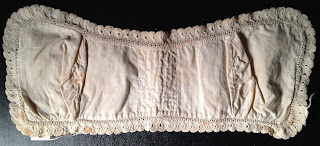 |
| Bust improver, upper surface, inscribed "Lavinia A. Norton/Vineland/N.J./1891." on underside (VHAS Collection) |
 |
| Bust improver, underside detail of bust improver pictured above (VHAS Collection) |
The VHAS counts these personal items among the many
fascinating costume treasures with local provenance in its collection. Extant
objects such as these bust improvers suggest the intimate ways ordinary women
engaged with the fashion of their times, personal habits that would be challenging
to untangle without material culture evidence.
From bust improvers to mundane cotton day skirts to rare
men’s paisley dressing gown, the contents of Vineland’s closet impressed us
at every turn. We gave each item the careful attention it deserved, describing
it thoroughly, taking its photograph, assessing its condition, and packing it
away for when VHAS will call upon it again to help tell Vineland’s stories.
 |
| VHAS costume collection carefully packed away, awaiting to be moved to more permanent storage in the new curatorial work room (Photo, UD Museum Studies) |
What
might we learn about bodies and hygiene from a purple silk dress, stained with
perspiration? How might we better comprehend some Americans’ late nineteenth-
and early twentieth-century reasons for donning Ku Klux Klan uniforms? How
might the carefully recorded family provenance and genealogies, spelled out on
tags and index cards, inspire current Vineland residents to save special items
from their own closets for subsequent generations to learn from? The questions
we can bring to the VHAS costume collection are endless, and answers to those questions will change each time we ask them. If Vineland's closet had not been full, we would not have been able to pose any questions in the first place.
~~~
Just a few weeks ago, the Vineland City Council invited us
back to thank us for our volunteer effort. When all was said and done, as a
group, we contributed over 1,000 volunteer hours. By any measure, we donated a
lot of energy and expertise to VHAS and the City's cultural heritage more generally. We earned the accolades we received for helping "sustain" Vineland's cultural heritage as a unique "place." But as a participant in the project, I benefitted too. I learned about Vineland's history and costume types (such as bust improvers) with which I was previously unfamiliar. I also I enjoyed the discussions I had with my colleagues about collecting philosophies and practices. And so I cannot thank
VHAS staff and board members enough for welcoming us into their space and for allowing us to take a
long, careful look through Vineland’s closet.
I look forward to taking that drive down Route 40 again soon!


